Making Smart Choices: A Guide to Trade-offs
So, what’s the big deal with trade-offs?
In software engineering, we make decisions all the time. Should we use a new, shiny technology or stick with the old, reliable one? Should we build a feature quickly or take the time to make it perfect? These are all trade-offs. It means you can’t have it all. You have to give up something to get something else.
This article will show you a cool way to look at these choices so you can make better decisions. It’s called the MECE framework.
The MECE Framework: A Fancy Name for a Simple Idea
MECE stands for Mutually Exclusive, Collectively Exhaustive. It sounds complicated, but it’s not.
- Mutually Exclusive means that each option you are considering is separate. You can’t choose two at the same time.
- Collectively Exhaustive means that you have thought of all the possible options. You are not missing anything.
Think of it like this: If you are trying to decide what to eat for dinner, your options might be pizza, tacos, or salad. These are mutually exclusive (you’ll probably only eat one for dinner) and collectively exhaustive (you’ve covered all the things you are willing to eat tonight).
A Good MECE Example: Trunk-based Development vs. GitFlow
Let’s look at a real-world example of a good MECE analysis. Imagine your team needs to choose a branching strategy. This is how you will manage changes to your code.
Two popular options are:
- Trunk-based Development: Everyone works on the same main branch, called the “trunk”.
- GitFlow: You use multiple branches for features, releases, and hotfixes.
These two options are mutually exclusive. A team will choose one way of working. They are also collectively exhaustive for this example, as they represent two of the most common and opposite approaches.
Here is a simple diagram:
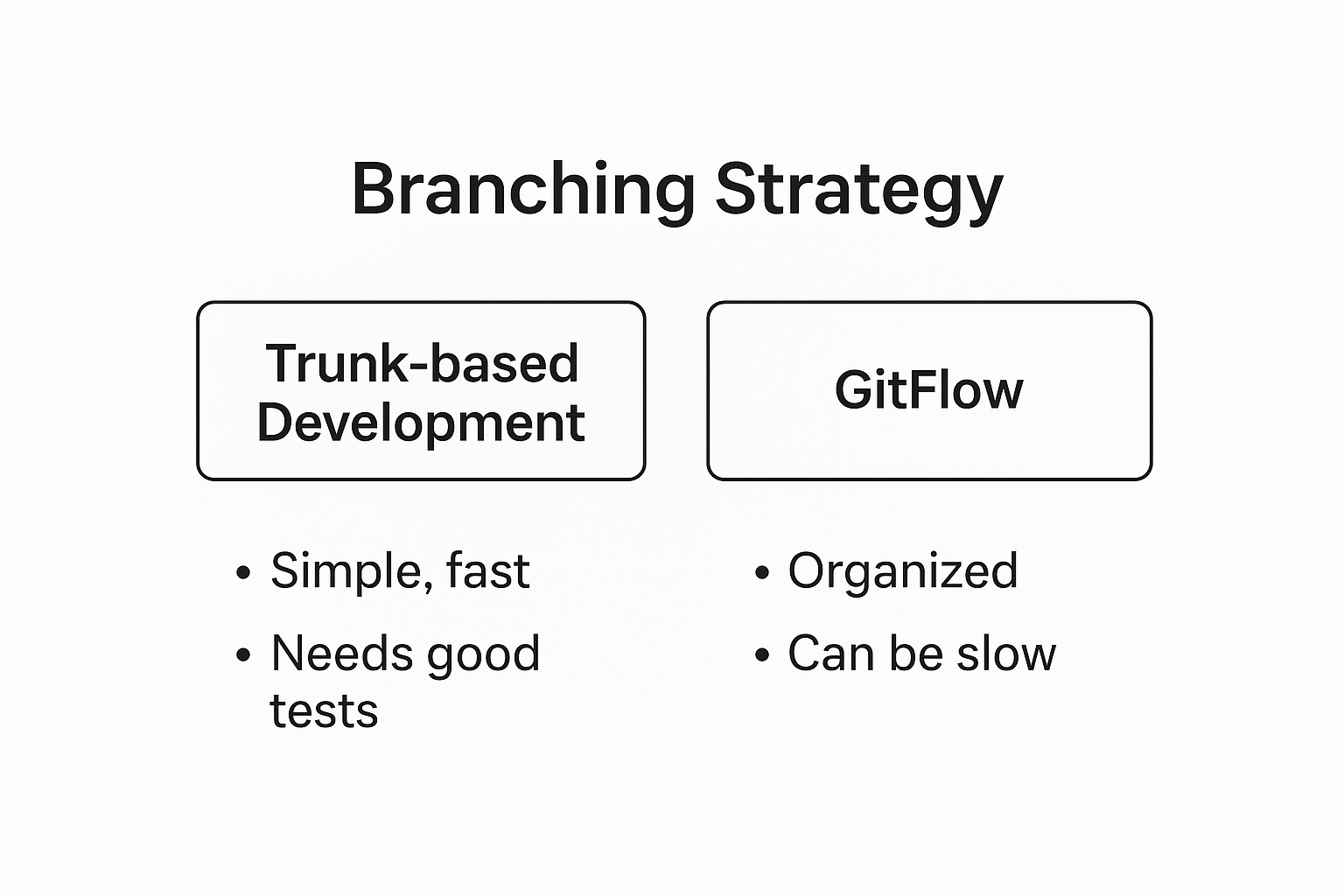
By comparing them like this, your team can have a clear discussion about what works best for you.
A Bad MECE Example: AWS SQS vs. EventBridge
Now, let’s look at an example that is not MECE. This is a common mistake.
Someone might ask: “Should we use AWS SQS or AWS EventBridge for our application?”
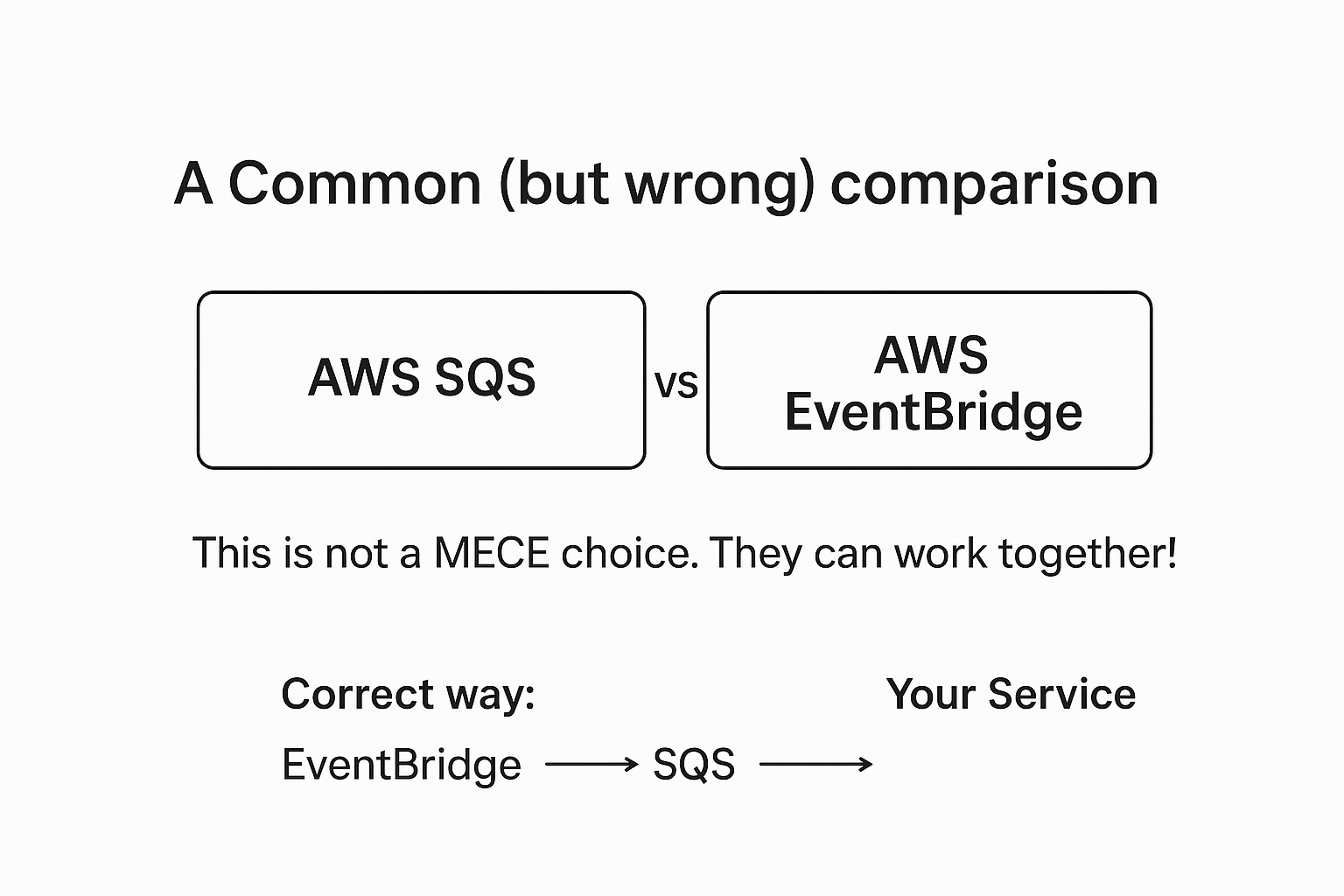
This is not a good MECE comparison because these two services are not mutually exclusive. They can be used together.
- AWS SQS is a message queue. It holds messages for other services to process.
- AWS EventBridge is an event bus. It sends events between services.
In fact, a common pattern is to use EventBridge to route events to an SQS queue. So, you are not choosing one or the other. You might use both.
Wrapping it Up
Making decisions in software engineering is tough. There are always trade-offs to consider. But if you use the MECE framework, you can make sure you are looking at the problem in a clear and organized way. It helps you see all your options and make the best choice for your project.